Channels
Buffers are a useful to encode the synchronization of workflow activities in the structure of the workflow itself. However sometimes a deeper coupling between services is needed.
Recall that “messages” that are passed between operations in a workflow can be
any data type that can be safely moved between threads. This includes endpoints
of channels—e.g. Sender and Receiver. By
streaming out a Receiver as a message, the service that gets the Receiver can
listen to ongoing activity in your service while both services run in parallel.
Or by streaming out a Sender, the service that gets the Sender can send data
back to your service while both services run in parallel.
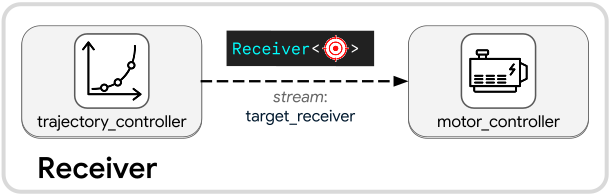
Suppose we have trajectory controller service and a motor controller service in
a workflow. The trajectory controller might update at a frequency of 50Hz while
the motor controller updates at a frequency of 1000Hz. There isn’t a natural way
for the structure of the workflow itself to synchronize these services, but the
trajectory controller could send a Receiver to the motor controller service,
allowing the motor controller to run its feedback loop at its own rate and
receive new targets as they arrive.
We use a stream to send out the receiver because streams
can send messages out of the service while the service continues to run. This
means the trajectory_controller service and motor_controller service can run
simultaneously as async services, and those specific service sessions can
communicate via the channel of the Receiver.
This can also be used to draw data into a running service. Suppose we want to
consider environmental hazards that should alter the path of the trajectory or
maybe even bring the robot to a stop. We could introduce a safety_monitor
service:
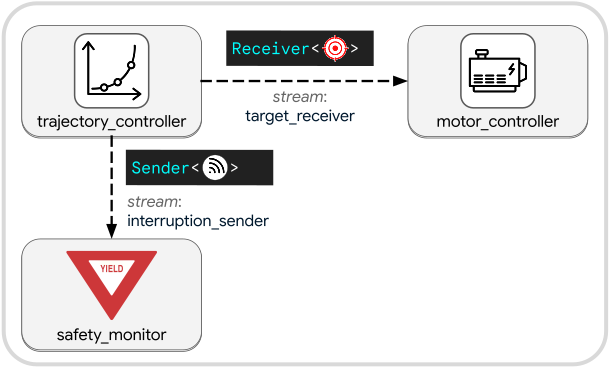
The trajectory_controller can send out a Sender over a second
output stream. This sender is used by the safety_monitor service to feed
moving obstacle information back into the trajectory_controller. Rather than
outright killing the trajectory_controller service to respond to obstacles,
we can feed the service with the information it needs to respond to obstacles.
Caution
Channels are a powerful way to set up long-running one-way or two-way communication between async services in a workflow that run in parallel, but there is a notable drawback. If you want to visualize the execution of the workflow, data sent between services over channels will not be traceable. If you care about traceability, you should consider copying all channel data to an output stream for logging.