Reachability
An important thing to consider for the lifecycle of a workflow is whether it’s even possible for the workflow to end. If a workflow is allowed to keep running indefinitely with no possibility of reaching the terminate operation, then the caller who made the request will be left hanging forever. This can lead to undesirable program behaviors like deadlocks.
To mitigate this problem, crossflow calculates the reachability of the terminate operation each time an event occurs that could influence whether the terminate operation can be reached. If at any point the terminate operation is no longer reachable, then the session of the scope will automatically be cancelled.
Note
An operation is reachable if there exists at least one plausible path to the operation from a currently active operation.
Inherent Unreachability
One kind of unreachability is inherent, meaning the very structure of the workflow makes it impossible for the terminate operation to ever be reached.
One way to get inherent unreachability is if nothing at all is connected to the terminate operation:
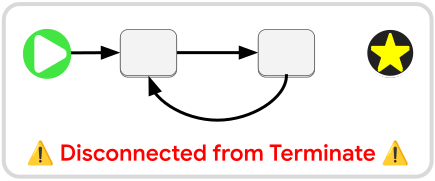
A slightly more subtle version of inherent unreachability is when there is no path from the start operation to the terminate operation because each is part of a separate island of operations:
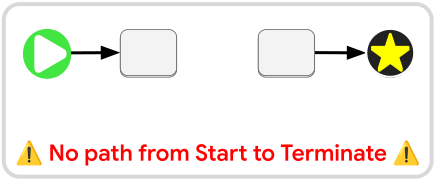
In either case, this unreachability will be detected immediately. Before the initial message is even sent out by the start operation, crossflow will detect that the terminate operation cannot be reached from the start operation, and the workflow will be instantly cancelled without any operations running.
Conditional Unreachability
Inherent unreachability fully prevents a workflow from running, but most of the cases where we need to think about unreachability, it depends on runtime conditions. Depending on which branch(es) are activated by an operation in the workflow, the terminate operation might become unreachable.
Consider this simple fork-result example:
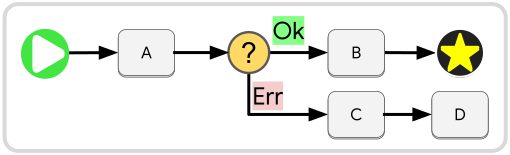
The branch going to node B will lead to the terminate operation whereas the
branch going to node C never will. If the message produced by node A has an
Ok value then the workflow will have no problem reaching the terminate operation.
But for an Err value:
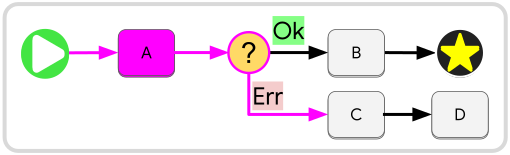
In this case crossflow will detect that the Ok message was “disposed” by the
fork-result operation and immediately perform a reachability check for the
terminate operation. Before node C even receives the message out of A, the
workflow will be cancelled because the terminate operation is not reachable.
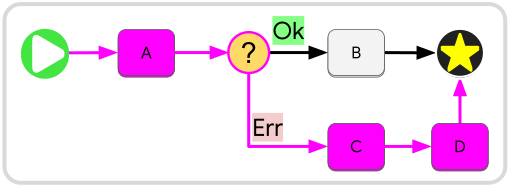
Fixing this problem is relatively simple. You just need to connect node D to
the terminate operation:
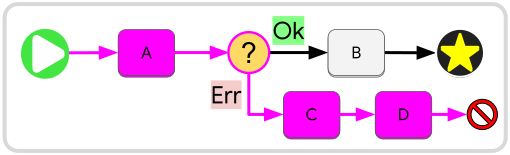
There may be cases where you actually do want the Err branch to cancel your
workflow because only node B can correctly provide the final output of the
workflow, but you nevertheless want nodes C and D to run before the workflow
delivers its cancellation message.
A simple way to achieve this is by connecting D to an explicit cancel operation.
The workflow will be considered “reachable” if either the terminate or operation
or an explicit cancellation operation is still reachable. As long as there is a
way for your workflow to eventually close itself down, it will be allowed to keep
running.