Branching
What distinguishes a workflow from a series is that workflows support additional operations besides just chaining services together. For example, fork-result creates a fork (a point with diverging branches) in the workflow where one of two branches will be run based on the value of the input message:
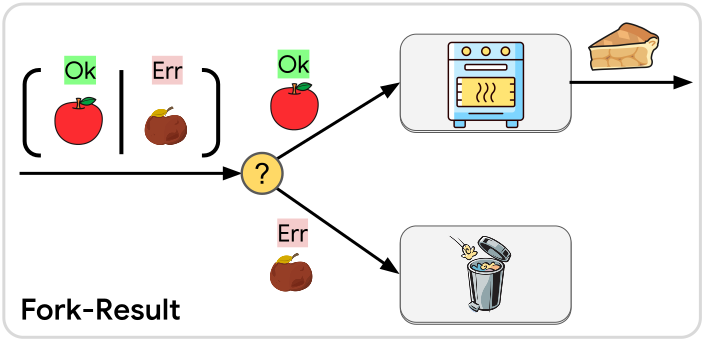
The input message of a fork-result must be the Result<T, E>
type. Result is an enum
with two variants: Ok and Err. The Ok variant will contain an object of
type T while Err will contain a type E. T and E can be any two data
structures of your choosing.
Each variant gets its own branch coming out of the fork-result operation. Each
time a message is sent into the fork-result operation, exactly one branch will
activate depending on whether the message is an Ok and Err variant. In Rust,
an instance of an enum can only have a value of exactly one of its variants.
We say that fork-result does “conditional branching” because it creates a fork in the workflow where one or more branches might not be activated when a message arrives.
Trigger
Another conditional branching operation is fork-option. Similar to Result<T, E>,
the Option<T> type in Rust is an enum
with two variants: Some and None. What makes Option different from Result
is that the None variant has no inner value. An Option<T> either contains some
value T or it contains no value at all (similar to
std::optional
in C++).
When we fork an Option we still produce two possible branches:
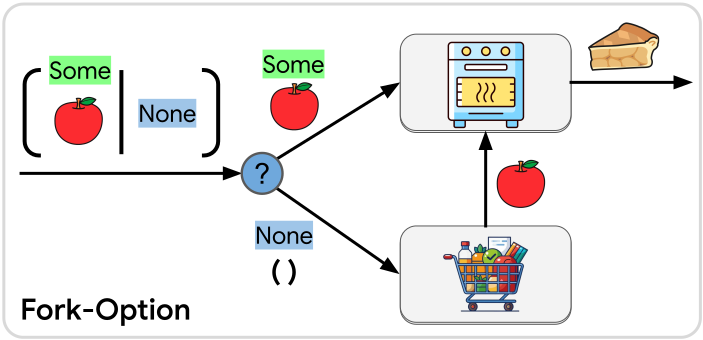
The branch for Some will carry the inner T message that the Option contained,
but the None branch has no value to carry. Instead it contains a message of
the unit type represented in Rust code as an empty tuple ().
The unit type concept is a useful one in workflows. It’s a way of sending a signal that some branch in the workflow should activate but there is no meaningful data to transmit. We refer to this pattern as a “trigger”, and operations that produce a unit type are called triggers.
In the above example we check whether an apple is available. If it is, we send it to the kitchen to be baked into a pie. If no apple was available then we go to the supermarket and bring back an apple to send to the kitchen. The context of the workflow is enough for us to know that we need to pick up an apple from the supermarket (this information could be embedded in the service configuration), so a trigger with no message data is sufficient to activate that service.
Note
If you have a custom enum type that you would like to use for forking, we have an open issue ticket to add support for this.