ROS 2
Support for ROS 2 is implemented using rclrs.
We provide generic registration functions that allow you to register node builders for individual messages, services, and actions.
Currently this means message, service, and action definitions need to be registered into the executor at compilation time.
This restriction will be lifted once rclrs supports dynamic messages.
Use the ros2 feature flag of crossflow to enable this support:
# Cargo.toml

[dependencies]
crossflow = { version = "*", features = ["diagram", "ros2"] }
Setup
Caution
The ROS 2 support currently involves some complicated colcon setup and therefore is being kept to the
ros2branch of crossflow for now. We should be able to merge it intomainoncerclrssupports dynamic messages.
Follow the instructions on the README of the ros2 branch to set up a colcon workspace with the necessary dependencies.
Note
This currently uses forks for
rosidl_rustandrosidl_runtime_rsto haveschemarssupport. There will be an effort to move this support upstream to the original repos.
Registering Primitives
To register support for a specific message, service, or action, start by creating the node that will be used by the ROS 2 primitives.
Pass that node along to registry.enable_ros2(node), which will provide an API that you can chain message, service, and action registrations onto.
use crossflow::prelude::*;
use rclrs::*;

use nav_msgs::{
    msg::Path,
    srv::GetPlan,
    action::GetMap,
};

// Create an rclrs executor and node.
let context = Context::default_from_env().unwrap();
let mut executor = context.create_basic_executor();
let node = executor.create_node("crossflow_executor").unwrap();

// Use the node to register the specific message, service, and action types.
let mut registry = DiagramElementRegistry::new();
registry
    .enable_ros2(node)
    .register_ros2_message::<Path>()
    .register_ros2_service::<GetPlan>()
    .register_ros2_action::<GetMap>();

// Spin the executor on a separate thread since it needs to run alongside Bevy.
std::thread::spawn(move || {
    executor.spin(Default::default());
});
Configuration
Subscriptions, publishers, and service clients are configured using PrimitiveOptions in JSON format.
Since action clients have multiple independent QoS to consider, they are configured using ActionClientConfig in JSON format.
In both cases, the topic/service/action name is the only mandatory field. All the QoS settings are optional. Any unset QoS will use the default setting for whatever primitive it’s being applied to.
Subscription
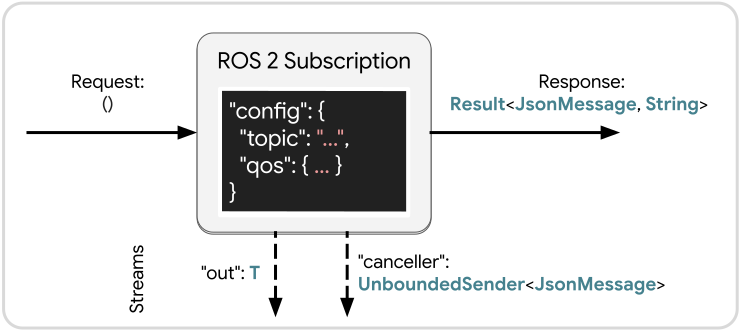
Subscriptions allow your workflow to receive messages from anonymous publishers that publish to the same topic that you’ve subscribed to. Once the node gets activated, it will stream out any incoming messages until it gets cancelled or until the scope it’s in finishes.
Request — A simple trigger that just prompts the node to begin listening for messages and streaming them out. Note that unlike the zenoh subscription it’s possible to activate redundant instances of this node. This issue is being tracked by #158.
“out” — Any messages received by subscription will be sent out of the "out" stream.
The message type will be the rosidl message struct that was registered rather than a JsonMessage.
“canceller” — In case you want to cancel the subscription, you can capture this [UnboundedSender], either storing it in a buffer or passing it to a node that can make a decision about when to cancel.
Triggering this will cause the final response of the node to be Ok(msg) where msg is whatever JsonMessage you pass into this sender.
Since subscriptions can last indefinitely, this is the only way to stop the node from running before the scope terminates.
Response — The final response of the node is a Result whose value is Ok if the subscription was cancelled using the "canceller", or Err if an error occurred.
Publisher
Publishers allow your workflow to send messages to anonymous subscribers whose topics match the topic of your publisher.
The ROS 2 publisher will be created when your workflow is created and reused across all sessions of the workflow. Note that this has some potential side-effects. If you configure the node to support late joiners then the late joiners will receive old messages even if the workflow session that sent those messages is no longer active.
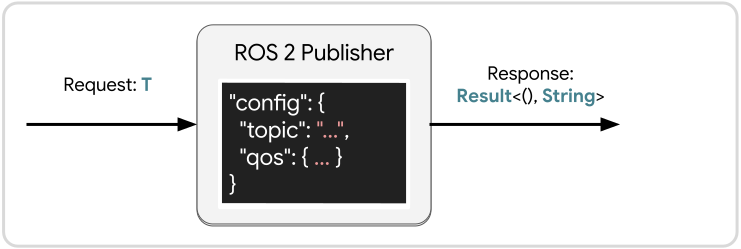
Request — Pass in a message of type T to publish, where T is the message type that the node builder is meant for.
Response — A Result which will be Ok if publishing the message was successful, or Err if the message failed to publish.
Client
Clients (for services) allow your workflow to send a request to a service and get back a response. Clients and services have a 1-to-1 relationship with each other: For every one request you send, you get exactly one response back (in the absence of errors).
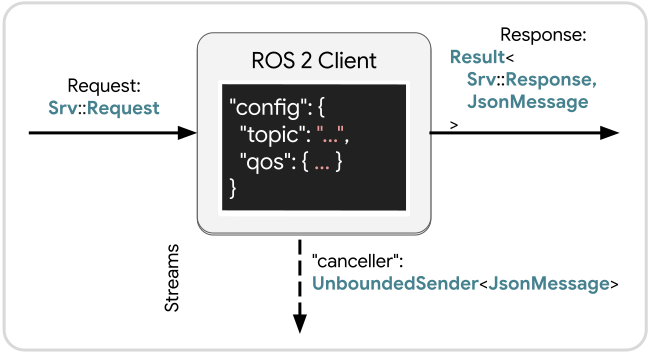
Request — Pass in the Srv::Request type associated with the service Srv that was registered for this node builder.
Response — A Result which will be Ok containing the Srv::Response from the server when the response gets delivered successfully.
If the canceller is triggered before the response arrives, this will be Err containing the cancellation message.
If any other error happens that interferes with the service, this will return an Err(JsonMessage::String(_)) describing the error.
“canceller” — Similar to the "canceller" for subscriptions, this allows the service to be cancelled before the response has finished arriving.
Action Client
ROS 2 actions represent a combination of topics and services that altogether describe an “action” (usually a physical process) which takes place over a period of time and involves incremental updates while it makes progress.
Anyone unfamiliar with ROS 2 actions is encouraged to read through the action tutorial.
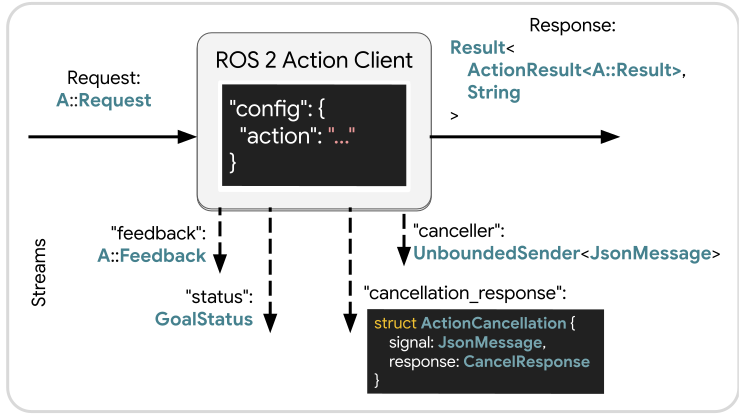
Request — Pass in the A::Request type associated with action A that was registered for this node builder.
Response — A Result which will be Ok containing the A::Response and GoalStatusCode from the action server when the response gets delivered successfully.
If an error happens internally that makes the result undeliverable, a string message describing the error will be returned in Err.
“feedback” — Stream of the action’s feedback messages.
“status” — Stream of the action’s goal status updates.
“canceller” — Send a request to cancel the action.
Unlike subscriptions and services, an action server gets notified about a cancellation and can respond to it accordingly.
Therefore triggering this does not immediately cancel the node.
Instead the cancellation request will be sent to the action server, and "cancellation_response" will stream out the response from the action server, along with the JsonMessage of the cancellation request that it’s responding to.
Once the action is successfully cancelled by the action server, the result and status will be sent out of the node’s final response wrapped in Ok.
“cancellation_response” — Stream of the action server’s responses to any cancellation requests sent to "canceller".
The message that was passed into "canceller" will be included in the output.
If the action’s communication is working correctly, there will be one message sent from this stream for every message sent through the "canceller" of an active action.