Multi-Agent State Machines
Listeners are excellent at multiplexing messages coming from many sources at once. This makes them well equipped to manage state machines that involve multiple independent agents that need to be orchestrated.
Suppose we have three robots:
- A machining robot that takes raw material and cuts (machines) it into a particular shape.
- A painting robot that takes machined material and applies paint to it.
- A tending robot that moves material around the work zone, passing it all between the other machines and the supply areas.
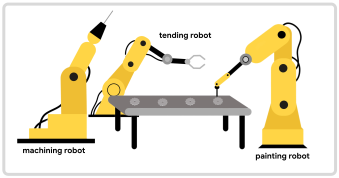
We also have three supply areas within the work zone:
- The raw material supply is where raw material gets dropped off to be processed.
- The machined material supply is where machined material is kept until the painting robot is available to work on it.
- The finished material supply is where painted (finished) material is placed until it can be taken away.
For the overall flow we want the raw material to be moved to the machining robot,
but only when the machining robot is available. We want machined material
to be moved to the painting robot but only when the painting robot is available,
otherwise it should be moved to the machined material supply. Finally painted
material should be moved to the finished material supply. Each time material
is moved to the machining robot or the painting robot, that robot should begin
working on the material that it received.
We can express that with the following workflow:
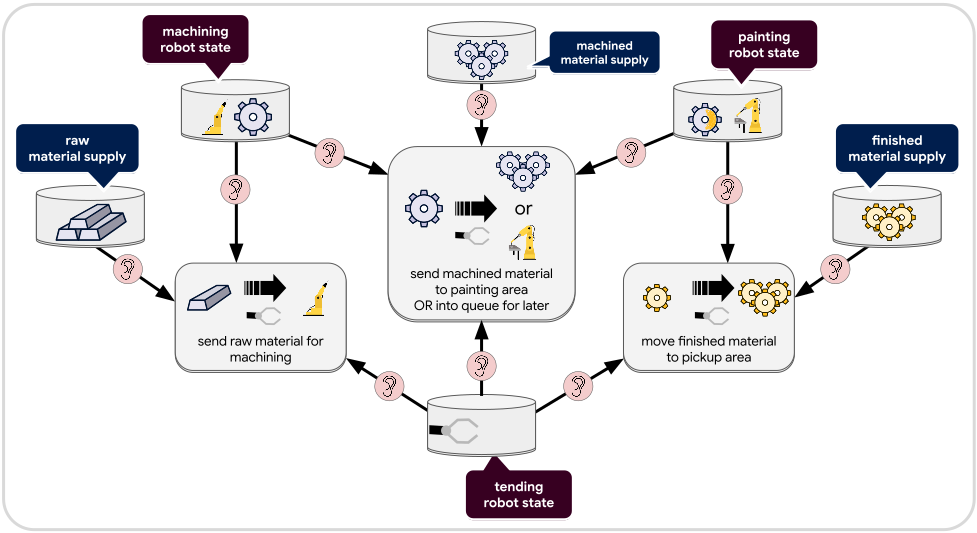
We define six buffers in total: one for each of the three robots and one for each of the three material supplies. Each of these buffers can be thought of as representing a variable in the multi-agent state machine. Each time a value changes for one of these variables, a relevant service will be activated to make decisions about what state transitions should take place:
1. send raw material for machining
Connected to the raw_material_supply, the machining_robot_state, and the
tending_robot_state, this service will be activated any time one of these
events happen:
- New material is added to
raw_material_supply - The machining robot becomes available
- The tending robot becomes available
Technically there are other events that can activate the service (e.g. the tending robot begins a new task), but the service will exit early when evaluating irrelevant events.
When any of the above events trigger the service, it will check if all of the following conditions are met:
- Raw material is available in the
raw_material_supply - The machining robot is available
- The tending robot is available
When all conditions are met this service will:
- Claim the tending robot by setting the
tending_robot_statebuffer to Busy - Claim the machining robot by setting the
machining_robot_statebuffer to Busy - Begin this async routine:
- Command the tending robot to pull an item from the raw material supply
- Reduce the count in the
raw_material_supplybuffer - Place the item in the machining robot area
- Release the tending robot by setting
tending_robot_statebuffer to available - Command the machining robot to perform its machining process
- When the machining robot is finished, change the value in
machining_robot_stateto Finished
If any one of the conditions is not met, then the service will not do anything.
2. send machined material to painting area OR into queue for later
Connected to machining_robot_state, machined_material_supply, painted_robot_state,
and tending_robot_state, this service will be activated any time one of these
events happens:
- The machining robot finishes a job
- The tending robot becomes available
- The painting robot becomes available
Technically there are other events that can activate the service (e.g. the machining robot or tending robot begins a new task), but the service will exit early when evaluating irrelevant events.
When any of the above events trigger the service, it will check whether the conditions are met for each of the following scenarios, in order, until it finds a scenario that is satisfied. The first one satisfied will be executed and the rest will be skipped:
🠚 move material from machining robot to painting robot
Conditions:
machining_robot_stateis Finishedpainting_robot_stateis Availabletending_robot_stateis Available
Execution:
- Claim the tending robot by setting
tending_robot_statebuffer to Busy - Claim the painting robot by setting
painted_robot_statebuffer to Busy - Begin this async routine:
- Command the tending robot to pull the material from the machining robot area
- Once the machining robot area is clear, set
machining_robot_stateto Available - Move the material to the painting robot area
- Release the tending robot by setting
tending_robot_statebuffer to available - Command the painting robot to perform its painting process
- When the painting robot is finished, change the value in
painting_robot_stateto Finished
This transition has the benefit of efficiently making the machining robot available and beginning the painting in one fell swoop, skipping the intermediate machined material supply.
🠚 move material from machining robot to the machined_material_supply
If the first scenario was skipped then either the painting robot is busy or the machining robot had no material available. We should prioritize clearing the machining robot so more material can be machined as soon as possible.
Conditions:
machining_robot_stateis Finishedmachined_material_supplyhas capacity for more itemstending_robot_stateis Available
Execution:
- Claim the tending robot by setting
tending_robot_statebuffer to Busy - Begin this async routine:
- Command the tending robot to pull the material from the machining robot area
- Once the machining robot area is clear, set
machining_robot_stateto Available - Move the material to the machined material area
- Increment the
machined_material_supplyvalue by one - Release the tending robot by setting
tending_robot_statebuffer to Available
🠚 move material from machined_material_supply to painting robot
If the first two scenarios were skipped then we cannot clear out the machining
robot at this time. Now we should check if we can move any machined material
from the machined_material_supply to the painting robot.
Conditions:
machined_material_supplyis greater than zeropainting_robot_stateis Availabletending_robot_stateis Available
Execution:
- Claim the tending robot by setting
tending_robot_statebuffer to Busy - Claim the painting robot by setting
painted_robot_statebuffer to Busy - Begin this async routine:
- Command the tending robot to pull material from the
machined_material_supply - Once the material is retrieved, decrement the value in the
machined_material_supplybuffer - Move the material to the painting robot area
- Release the tending robot by setting
tending_robot_statebuffer to available - Command the painting robot to perform its painting process
- When the painting robot is finished, change the value in
painting_robot_stateto Finished
- Command the tending robot to pull material from the
🠚 else
If none of the above scenarios are satisfied, then this service will do nothing.
3. move finished material to pickup area
The final service is responsible for clearing material from the painting robot.
Connected to painting_robot_state, finished_material_supply, and tending_robot_state,
this service will be activated any time one of these events happens:
- The painting robot finishes a job
- Material is taken from the
finished_material_supply - The tending robot becomes available
Technically there are other events that can activate the service (e.g. the tending robot begins a new task), but the service will exit early when evaluating irrelevant events.
When any of the above events triggers the service, it will check if all of the following conditions are met:
finished_material_supplyhas capacity for more itemspainting_robot_stateis Finishedtending_robot_stateis Available
When all conditions are met this service will:
- Claim the tending robot by setting the
tending_robot_statebuffer to Busy - Begin this async routine:
- Command tending robot to pull material from the painting robot area
- Once the painting robot area is clear, set
painting_robot_stateto Available - Move the material to the
finished_material_supply - Increment the
finished_material_supplyvalue by one - Release the tending robot by setting
tending_robot_statebuffer to Available
Conclusion
The above workflow defines a highly parallelized process involving three agents that opportunistically keeps material moving whenever the right agents are available. Underlying this workflow is a state machine that combines the state information of all three agents and three material supply areas. Transitions for this state machine are asynchronous and can overlap with each other without negatively interfering with each other because their activities are orchestrated through their shared use of the buffers.
The logic of each of the state transitions that can be performed are encapsulated by three different services that do not need to know about each other’s existence. Each of these services can be implemented as an async function or by defining a separate lower-level workflow for each of them.
This kind of free-form reactive async system cannot be expressed by most graphical programming paradigms. Behavior Trees generally cannot express this kind of open-ended reactivity, and even most Petri Net implementations cannot express async transitions that gradually modify state variables (“places” in Petri Net terminology) throughout the execution of the transition.